Prevent AI model updates from disrupting business operations and revenue streams.
- Gartner client? Log in for personalized search results.
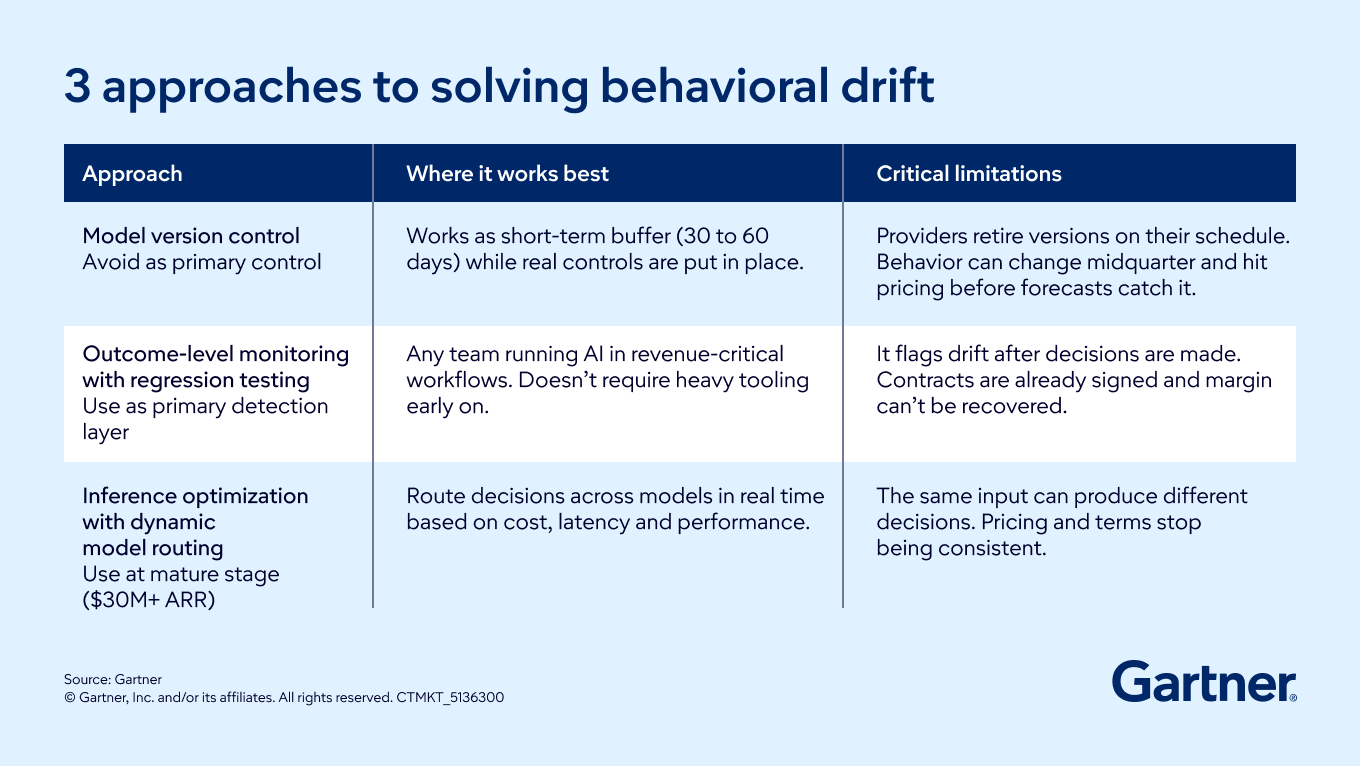
AI models are evolving and revenue exposure is rising
As AI foundation models evolve and AI-driven decisions become more pervasive, behavioral drift has transformed from an IT concern into a board-level financial risk. Behavioral drift occurs when an AI system’s real-world outputs begin to diverge from the behavior that was originally tested, validated and expected. Gartner Senior Director Analyst Mario Capellari warns, “These unnoticed shifts can unilaterally rewrite pricing strategies, lead to loss of ROI and increase customer churn, all of which bypass traditional technical detection methods.” By 2028, Gartner forecasts revenue tied to unmonitored AI will surge from $150 billion to $1 trillion.
Because these shifts often go unnoticed, no one owns the fallout when AI models drift. As update cycles accelerate and models grow more complex, tech CEOs face growing pressure to anticipate and respond to these board-level risks.
How tech CEOs can reduce the financial risks of AI updates
Gartner recommends that technology CEOs take proactive steps to reduce risks for pricing, renewals, margins and contractual obligations. Managing these risks requires stronger financial controls, executive accountability and contractual safeguards.
Establish outcome-level testing as the primary detection layer
Outcome-level monitoring and regression testing should serve as the first line of defense for AI systems. Define and enforce acceptable performance ranges for every AI-driven workflow, then continuously monitor outputs over time to detect behavioral drift as models, data and business conditions evolve.
This approach is particularly effective for teams running AI in revenue-critical processes because it provides clear visibility into performance without requiring significant tooling or infrastructure investments early on. However, outcome-level testing is inherently reactive. It identifies drift only after decisions have been made, which can leave organizations exposed when contracts are already signed or lost margin cannot be recovered.
Establish financial guardrails and ownership
Immediately identify and monitor the two or three autonomous workflows closest to pricing, discounting or renewal decisions. Tracking week-over-week variance in financial outputs for identical customer profiles can help detect behavioral drift before it materially affects revenue or margins. Any sudden pricing shift should trigger an automated alert to the CFO or other executive leadership.
Designate a single accountable executive owner with the mandate, budget and responsibility to manage behavioral drift risk. This responsibility should remain at the business leadership level, rather than being delegated to engineering, because behavioral drift is an enterprise risk rather than an IT issue.
Build operational controls into automated decisions
Hard code financial protections into core business systems by mandating a gross-margin floor within ERP or billing platforms for all automated transactions. These controls help ensure that autonomous decisions remain within approved financial boundaries.
If behavioral drift pushes an automated pricing recommendation below the defined threshold, the system should immediately freeze the workflow and require explicit executive approval before the transaction can proceed. This provides a critical safeguard against unintended financial exposure.
Strengthen contracts and limit liability
Over the longer term, work with legal teams to define the risks associated with evolving third-party foundation models in master service agreements. Client contracts should clarify that behavioral drift is a natural characteristic of AI systems, rather than a breach of software warranties or service-level agreements, and acknowledge that related costs may require periodic renegotiation.
Companies should also shift responsibility for monitoring high-risk AI outcomes to customers by requiring human-in-the-loop validation for critical workflows. To further contain exposure, segment contract exposure, establish stand-alone liability caps for autonomous or agentic decisions, and set clear financial limits on behavioral drift losses so they do not affect broader liability obligations.
What to do next to drive next-generation business models through AI
AI is creating new opportunities to redefine how organizations deliver value, generate revenue and compete. To capture these opportunities, leaders must move beyond experimentation and systematically design, validate and scale AI-enabled business models.
The steps in that journey include:
Understanding the current AI adoption environment by assessing how customer approaches to buying, renewing and expanding AI deployments are evolving, identifying the expectations and challenges shaping adoption decisions, and finding ways to help customers achieve value faster
Discovering AI opportunities by identifying where AI can create new ways of delivering value, reshape business and operating practices, and support the development of minimum viable products or services with clearly defined customer outcomes
Designing and prototyping AI-enabled solutions by developing and testing innovative AI-driven concepts, validating expected outcomes with beta and production customers, and refining solutions based on real-world results
Implementing and integrating new AI-driven models into products, operations and pricing by embedding AI into offerings and business processes, aligning operating models to support adoption, and pricing solutions based on the outcomes delivered to customers
Measuring, refining and optimizing AI business models by regularly evaluating customer outcomes and market performance, ensuring AI-enabled offerings outperform competitive alternatives, and using those insights to strengthen differentiation and drive continuous improvement
AI model update risks FAQs
How can tech CEOs manage revenue risks from AI model updates?
Tech CEOs can reduce revenue risk by establishing financial guardrails around AI-driven pricing, discounting and renewal processes. Gartner also recommends building operational controls into ERP and billing systems, including gross-margin floors that automatically stop transactions and require executive approval if AI-generated recommendations fall below approved thresholds.
What contractual protections help tech CEOs reduce cost risk from AI updates?
Organizations can reduce cost and liability exposure by updating contracts to address the evolving nature of third-party foundation models. Master service agreements should define how AI models are used and clarify that behavioral drift is a natural characteristic of AI systems, rather than a breach of warranties or service-level agreements. Require customers to maintain human-in-the-loop validation for high-risk workflows, establish stand-alone liability caps for autonomous decisions and set clear financial limits on behavioral drift losses to prevent them from affecting broader liability obligations.
Why is executive ownership of AI model update risk essential?
Compliance can look backward and product governance can address risks before launch, but no one owns the consequences when AI models drift. That’s why it’s important to assign a single executive leader with authority and budget to oversee and act on AI drift risk.
Attend a Conference
Accelerate growth with Gartner conferences
Gain exclusive insights on the latest trends, receive one-on-one guidance from a Gartner expert, network with a community of your peers and leave ready to tackle your mission-critical priorities.

Drive stronger performance on your mission-critical priorities.