The green card program suspension creates an opportunity for CIOs and tech services leaders to rethink talent strategies and build resilience through local hiring, new delivery models and AI-enabled automation.
- Gartner client? Log in for personalized search results.
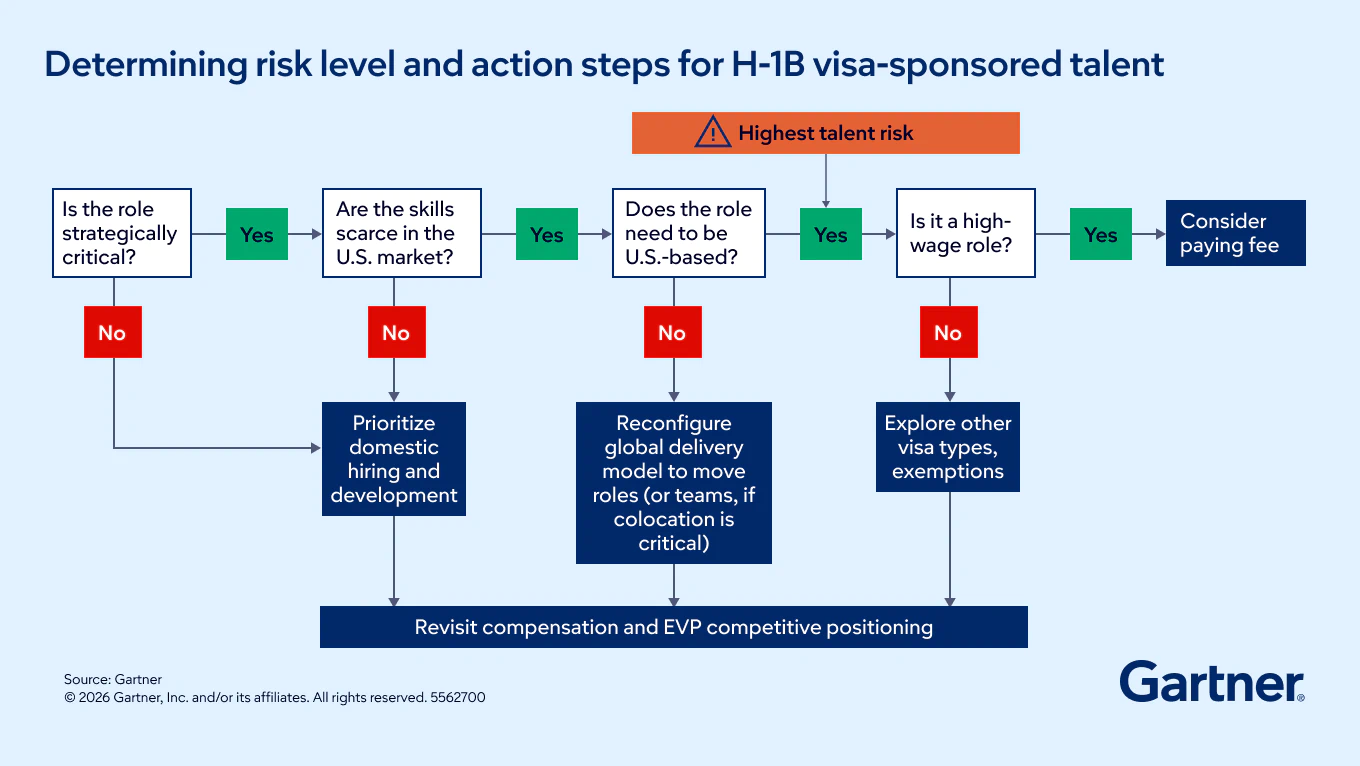
PERM suspensions expose critical vulnerabilities
On October 8, 2026, the U.S. Department of Labor announced the suspension of Microsoft and Adobe from its Permanent Labor Certification Program (PERM). The Labor Department further added that it won’t accept or process current applications under the program for a host of other companies, including Cognizant, Infosys, Capgemini, Tata Consultancy Services (TCS), Wipro and HCL. This comes after suspension of permanent labor certification for Cognizant and Cloudera on September 9, 2026, as the department investigates alleged fraud and potential disadvantages created for American workers. The suspension of PERM certification exposes deep structural vulnerabilities in technology enterprise staffing models. To maintain continuity, tech services leaders and CIOs should audit structural visa dependencies and accelerate local recruiting.
In response to this suspension, tech services providers should create a near-term resourcing plan to build a pipeline of resources who can be staffed on critical client engagements to meet services delivery and operational continuity. CIOs should also identify derisking strategies and revisit their sourcing strategies to avoid impact on their operations.


The suspension raises broader workforce and business concerns
According to the Labor Department, Microsoft laid off 6,000 American workers last year and obtained 6,300 H-1B visas and almost 3,000 green cards. Tech companies have heavily relied on these programs and these eight companies received 230,000 approvals for H-1B and 100,000 permanent labor certifications, per Labor Department Secretary Keith Sonderling. Microsoft has disputed that most of the H-1B visa applications were to extend or change the status of existing employees, not to hire new ones. TCS has said that its PERM applications have been in single digits over the past two years and it plans to hire 15,000 employees in the U.S. over the next five years.
Multiple programs targeted
The U.S. administration is now watching all the different programs that tech companies have been using, such as H-1B and PERM, to bring foreign nationals to work and stay in the U.S., as well as J-1 visas for international students.
The Labor Department has also called out nine universities for abusing J-1 visas to allow international visitors to temporarily come to the U.S. for work and study exchange programs. The universities called out for visa fraud are Harvard; Yale; Stanford; the University of Pittsburgh; the University of California, Davis; Caltech; Arizona State; and MIT.
This suspension makes it even harder for talent acquisition and to maintain staffing and delivery capacity. The $100,000 H-1B visa fee proposed on September 19, 2025, for workers outside the U.S. was another way to curtail H-1B visa use (see First Take: New H-1B Fee Reshapes U.S. Tech Provider Markets and Business Models). The new suspension further accelerates the dismantling of the labor arbitrage model of high-volume IT services firms by making lower-cost outsourced resources less viable.
The U.S. Department of Homeland Security (DHS) has also proposed a $70,000 fee for an international student’s Optional Practical Training (OPT) recommendation and a $30,000 fee for subsequent renewals.
Business model disruption for IT services providers
The IT services industry is already facing multiple threats, with compression on margins and revenue due to AI and launch of deployment and consulting companies from frontier model providers. This will further impact their ability to retain key noncitizen talent in U.S. onshore locations and provide onshore support.
This new suspension on the PERM program will further target the business model of IT services providers and tech companies by making it financially unviable to bring in foreign workers at junior and mid-levels. The current suspension does not cancel active H-1B visas, but workers approaching their six-year H-1B limit cannot extend their visas without an approved PERM. They risk having to leave the U.S. if their visa reaches its limit. The U.S. Department of Labor received 117,849 PERM applications during fiscal year 2025 and a majority of these are H-1B visa holders.
There are roughly 500,000 Indian citizens with H-1B visas in the United States and with this suspension on eight leading tech companies, a huge number may be impacted by the suspension.
What are the implications?
- This suspension could make it harder for IT services providers to retain top talent working and supporting clients and critical systems, creating shortages in highly specialized roles. Affected workers may be unable to pursue PERM applications, prompting them to leave the United States.
- This suspension could lead to extensive audits of prior labor hiring practices, including recruitment records and wage structures, which could result in additional operational challenges and prolonged uncertainty for both providers and their clients.
- The timeline to hire highly skilled talent locally will likely be time-consuming. Business and IT leaders may seek alternative staffing agencies or local providers, potentially triggering contract renegotiations.
- Increased competition for local talent could lead to bidding wars for high-demand skills, raising hiring costs and placing further pressure on workforce investments, operating margins and talent budgets.
- Demand for professionals with unrestricted work authorizations, such as U.S. citizens and green card holders, may drive up the pay rates at a time when services providers are already facing pricing pressure.
- The suspension could damage affected companies’ reputations and limit their ability to hire locally or win new business. Clients may view these providers as higher-risk partners due to concerns about possible staffing and continuity.
- Competitors not subject to the suspension may actively recruit top talent from the affected providers by offering more stable, long-term immigration pathways.
- If talent attrition leaves a critical project understaffed, clients may terminate contracts early and transition to alternative vendors who don’t have such restrictions, potentially paying premium rates for emergency replacement services.
Recommendations for tech providers
Protect delivery
- Create a near-term resourcing plan: The suspension can lead to unavailability of engineers waiting for visa extension. Tech services providers should create a near-term resourcing plan to leverage offshore and nearshore talent to meet services delivery and operational continuity. Build a pipeline of such resources who can be staffed on critical client engagements.
- Use AI to automate services: IT services companies have bullishly invested in developing AI platforms and agentic solutions for high-volume, low-complexity tasks and activities. Leverage these AI assets and agents to deliver more with less, and leverage human engineers for strategic work.
- Reinvigorate local recruitment: Tech services companies should plan to increase recruitment for tech talent in U.S. colleges and universities to hire local talent. Hiring teams should build relationships with local universities and colleges to create a talent pipeline.
Protect revenue and margins
- Conduct advance planning with legal teams: The suspension could lead to a request from the Department of Labor for detailed hiring, employment and visa records. Work with the legal team to plan responses to the Department of Labor requests as the investigation continues.
- Build communication plans for potential impact: Create scenario planning to identify the impact on clients and how these positions can be filled with overcapacity teams in other client engagements. Create a communication plan proactively for clients who will be impacted and a contingent plan for in-flight sales motions to limit disruption to prospective clients.
- Prepare for salary hikes: The administration has accused these companies of paying significantly lower salaries for outsourced resources on H1-B visas. These eight tech companies should prepare to be less price-competitive than other tech providers who have not been accused of fraud in PERM applications.
- Review contractual governance: Check change-in-law and change-in-regulation contractual provisions to determine whether increased recruiting, labor, compliance, subcontracting or relocation costs can be recovered. Confirm that these provisions are part of your standard contracting posture.
Recommendations for CIOs
- Conduct immediate workforce assessment: Check your current IT providers to submit an immediate audit of key personnel assigned to your projects. Identify how many are on vulnerable H-1B visas facing PERM deadlines.
- Ringfence key personnel: Review existing master services agreements (MSAs). Invoke “key personnel” clauses to legally obligate providers to replace departing visa holders with equally qualified, U.S.-authorized talent at no additional cost.
- Democratize vendor ecosystem: Begin scouting alternative, diversified IT services providers or boutiques that have clean regulatory standing to hedge against sudden disruptions in your primary tech talent pipeline.
- Explore global capability center (GCC) option: Explore the option for creation of GCCs as an alternative that will leverage resources from the offshore and minimize the disruptions.
Attend a Conference
Accelerate growth with Gartner conferences
Gain exclusive insights on the latest trends, receive one-on-one guidance from a Gartner analyst, network with a community of your peers and leave ready to tackle your mission-critical priorities.

Drive stronger performance on your mission-critical priorities.